Law, Ethics and News Literacy
While not always something at the front of people’s minds, this domain is one that plays a vital role in the work we do every day. A lot of my experience with it has been conceptual – more learning than application, but it’s something I keep in mind in each of the stories and various forms of journalistic communication I take part in.
Law and Ethics
Newsroom scenarios
In this assignment we were asked to read and annotate two newsroom scenarios. Each of these described situations in which ethical concerns were brought up. In our response, we were required to cite both the ODYSSEY Media Group Staff Handbook and the Society of Professional Journalists Code of Ethics, both of which we had spent a few days prior annotating, taking notes on and discussing. This activity was good practice in applying the lessons we had been learning to real-life situations.
"Shattered Glass"
In Journalism I, we watched the movie “Shattered Glass” about Stephan Glass, a reporter for The New Republic who fabricates several of his stories. Watching the movie and the discussion we had about it helped me fully apply all of the lessons we’d had about journalistic ethics and showed truly just how important safeguards like sourcing and transcriptions are. Shown above are my responses to the discussion questions.
NSPA preconvention notes
At this year’s National High School Journalism Convention, I had the opportunity to attend the Student Press Law Center’s Law and Ethics prevention workshop, which was really interesting. Topics included prominent court cases in scholastic press, copyright and the Freedom of Information Act. A lot of it was information I had learned about previously through my journalism class, but it went a lot more in-depth and it was really valuable to learn more about why scholastic journalism operates the way it does legally and ethically.
First Amendment essay
I wrote this essay for the Georgia Scholastic Press Association’s First Amendment Essay Contest when I was a freshman, the prompt for which that year was “In the First Amendment context, some scholars say it is possible to have a free society in which people have the right to call on the law to defend them against being offended or insulted. Other scholars say that is not possible. What do you think? Make an argument one way or the other.” With this, I tried to go in the direction of talking about what is and isn’t considered offensive and the ways in which human nature has a role in determining that. While this definitely isn’t my best work, it was a good way to combine the things I had been learning about in Journalism I with other classes like AP US Government and Politics.
Corrections and omissions

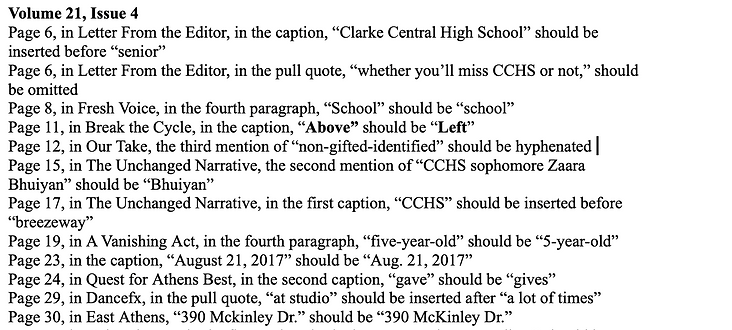

Something I did a few times during my freshman year was help out with Corrections and Omissions for the program’s newsmagazine, which is included in the next cycle’s magazine and posted in the “About” section of the website. While things like misspellings and AP Style errors aren’t ideal, they are inevitable and catching them ensures we maintain credibility as a publication and that we hold ourselves accountable.
Checklists

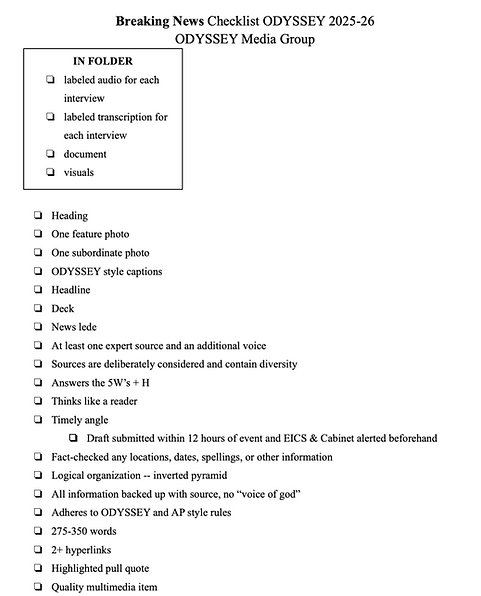


Every type of story we do comes with a checklist of items and requirements that must be met in order for them to get published. When editing, one of the first things I try to look for is if a checklist is filled out and if all items on the checklist have actually been met. I’ve also helped develop some of these checklists, the foundation of which are built around the same basic requirements. By making sure we’re meeting these requirements each time, we ensure that every story has each of the elements it needs to be told not only stylistically, but also factually and ethically.
Takedown requests

Over the past year-and-a-half, I;ve gotten several requests from past members of the program asking for stories they had written during their time in high school to be taken down, mainly for professional reasons. I decided to accommodate these requests, citing the ethical principle of Do No Harm as I believed not doing so might have led to unintended consequences for the writer.

In November, I received a request from a lawyer representing a former teacher of the school asking for a story about them to be taken down. After talking with my advisor, I decided to ignore the request as the reasoning didn’t quite take sense. However, after receiving several consecutive emails, we reached out to the Student Press Law Center, who also advised us to ignore the emails for similar reasons. After receiving two more emails, though, I reached back out to the SPLC with the draft of the email I intended to send to the lawyer. I got the go-ahead and since sending it, the requests have stopped.
AI Policy
Last semester, Print Editor-in-Chief Liza Larson and I worked together to write an artificial intelligence policy for our publications. The amount of AI usage was increasing in our school and we were beginning to see the effects in our newsroom, so we decided to take action. We took inspiration from the New York Times and Washington Post’s policies when writing this one. Although we haven’t yet been able to present it to our adviser, we’re hopeful it will be effective in reiterating our program’s expectations surrounding AI usage.
News Literacy
Finding inspiration

Something I do every couple of months is look through other publications, both scholastic and professional, and see what they have done that we can adopt. For me, this often means looking at what kind of multimedia packages other publications are doing and, if possible, what platforms they’re using to make them. I never copy from these, it’s just a good way for me to see inspiration for package designs or stories that can serve as a jumping off point for new ideas particularly when I’m hitting a wall with my own work.
What's Happening Now?

Since the beginning of last year, we’ve been posting weekly “What’s Happening Now” slideshows on our website and social media, giving a glimpse at international, national and local news stories. While I’m not the one directly producing these, I edit them each week, checking for inaccuracies and AP/ODYSSEY Style errors as well as making sure there’s a variety of the previously mentioned categories. I also try to stay up-to-date on current events throughout the week and help brainstorm what to include when necessary.
Practicing media literacy
This is an assignment we did at the beginning of my sophomore year as an introduction to the start of the print cycle. We were tasked with reading and viewing a variety of articles and packages from both scholastic and professional media outlets and analyzing them. We looked at the elements we had been discussing in class, such as story structure, balance, multimedia and accuracy. This was helpful not only in seeing the different things we’d be talking about actually applied but also gaining inspiration for our own stories and packages.